


President Donald Trump couldn’t resist.
Rob Reiner and his wife Michele were found dead less than 24 hours earlier, stabbed to death allegedly by a deeply troubled son who struggled with drug addiction for nearly 20 years. And President Trump took to Truth Social with a message for the grieving family that amounted to, basically: Your loved one had it coming.
Rob Reiner died, Trump wrote, “reportedly due to the anger he caused others through his massive, unyielding, and incurable affliction with a mind crippling disease known as TRUMP DERANGEMENT SYNDROME.”
Read that again.

The President of the United States suggested a murdered man was responsible for his own death because he criticized Trump too much. When reporters asked if he stood by these comments, Trump doubled down on camera: “He was a deranged person as far as Trump is concerned... I thought he was very bad for our country.”
I’m grateful Marjorie Taylor Greene condemned it: “Rob Reiner and his wife were tragically killed at the hands of their own son, who reportedly had drug addiction and other issues, and their remaining children are left in serious mourning and heartbreak. This is a family tragedy, not about politics or political enemies.”
But thinking back to my previous comments, when you’ve lost Marjorie Taylor Greene (someone who herself has said some pretty questionable things), you’ve gone somewhere dark.
If you’re worried about the temperature in this country, look no further than the President, who is leading by example and unable to comment on a tragic, grisly murder without turning it into a post about his political opponents. They hadn’t even made an arrest yet.
Meeting the Reiners
Years ago, Rob Reiner hosted a book party for Pat Cunnane, my wonderful colleague from the Obama White House, at their home. I met both Rob and Michele; I saw them again at another friend’s house. She was warm, eager to talk about motherhood and kids. He was passionate about causes (and quite outspoken in his views on Trump, it must be said). Rob and I disagreed about the Equal Rights Amendment, which I thought we needed to push for in the aftermath of Trump’s first election. He thought it had no path.
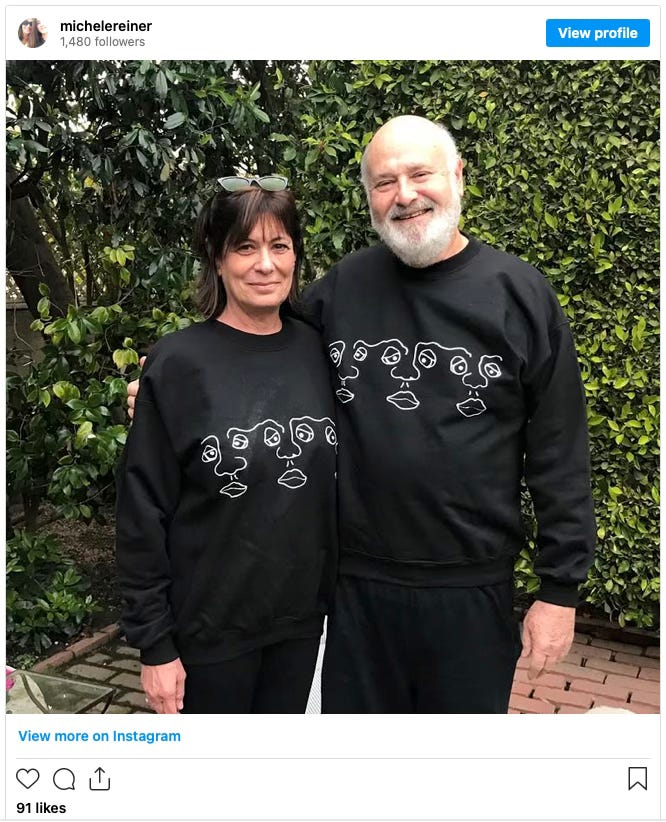
Now they’re gone.
And instead of a conversation about the epidemic destroying families across America – drug addiction, mental health crises, the systems that fail parents before violence erupts – we’re debating whether a President should mock a murdered man who can’t defend himself. As if the answer to that question isn’t obvious.
In the aftermath of Charlie Kirk’s assassination in September, there was a vanishingly brief moment when both sides condemned political violence. When we didn’t retreat to our corners. We called out heinous statements. Then the news cycle moved on. We never had a real reflection about why our discourse has become so toxic that people have taken to violence.
The circumstances of the Reiners’ murder are very different. And yet here we are again. Not mourning the dead but debating the politics of it.
Once again, we’re missing the point. This isn’t a story about a political opponent. It’s personal. It’s a 32-year-old man with a long history of addiction allegedly killing his parents. It’s a story too many American families know. And we’re wasting it on Trump’s ego.
The Bird with the Broken Wing
I know this story. Not from Hollywood, from my own family. Not a left-leaning family – my right-leaning family. We’ve been affected by a family member with drug addiction. Someone whose actions you could never predict. Someone who was unstable and you always worried about. Many tried to help, only to fail.
Even young I always wondered what the tragedy would be to end it.
In our case, it was an overdose in a basement. While his children will forever wear scars, that night only he would die. But when you’ve had that experience, you worry about the worst – something like what happened to the Reiners. Anyone who knows an addict knows that things can spiral unpredictably.
At my family member’s funeral, my grandmother spoke eloquently about trying to watch a bird with a broken wing try to fly. Families try everything, often without success, to find the child they once knew.
The Reiners made a movie about this in 2015. “Being Charlie,” directed by Rob and co-written by Nick Reiner, based on his own experiences with addiction and homelessness, which follows a son spiraling and parents struggling, sometimes too distracted in their own lives. In the 2015 film I saw a father keep his distance, believing that professionals could help. From the interviews around that movie it seemed they thought they were on a positive trajectory. But those of us who know addiction know the story is rarely over.
I have no idea what transpired in the decade since. But I imagine there was pain. There was love. There were efforts that didn’t work. And now there are surviving children left to process that their brother allegedly killed their parents.
The majority of murders are committed by someone the victim knows. This isn’t a political story. It’s a public health crisis playing out in private homes across America, regardless of wealth or fame or politics.
The Conversation We’re Not Having
As the media seizes on every gruesome detail of the Reiner tragedy and Trump’s awful comments we seem to miss that fragile people are involved. Headlines read “Rob Reiner’s son arrested,” as if Michele wasn’t equally his parent, equally his victim. Stories breathlessly report Rob and his son were fighting at Conan O’Brien’s Christmas party, all based on gossip. I can’t imagine the family having to read these stories.
Why can’t we stop ourselves from wallowing in the gruesome and political?
Last week I wrote about how raising kids, the toughest job, the one with the biggest impact on our lives, is undervalued. So many struggle through. Too many with a child facing addiction. And when tragedy strikes, instead of asking how we prevent the next one, how we help those in need, we turn it into a spectacle.
What we should be discussing:
Why is it so many in our country are turning to drugs? How do we identify families in crisis before violence occurs? What support systems exist for parents when their child battles addiction? Is our criminal justice system equipped to handle mental health and substance abuse, or does it fail families until it’s too late? Why do we only talk about these issues after the body count?
Rob and Michele Reiner deserved better than to become a political football. Their surviving children who are grappling both with a mentally ill brother and the loss of their parents deserve better than watching their family tragedy weaponized by a president settling scores with a dead critic. And we deserve better than this moment.
We missed the conversation after Charlie Kirk’s death. We’re missing it now. Until we can move past our political obsessions and confront the crises destroying too many families – addiction, mental health, violence, systems that fail us – we’ll keep missing it.
That’s the real tragedy.
Hi Johanna. A very good read. Thought I’d mention that we just returned from a guided tour of Australia and New Zealand where two of our fellow travelers were from Galesburg. One, Margaret Tolley, said she knew you or knew about you. Small world given there were only 19 of us. One of our stops was at Bondi Beach. How the shooter had six guns is mystifying given how tightly controlled guns are there. By the way, congratulations on your pregnancy. Wishing you all the best.