


Are we about to see a geopolitical bromance?
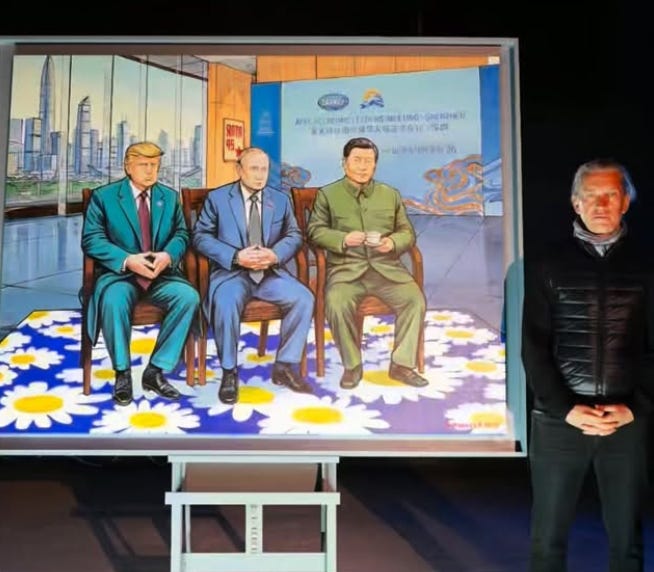
Three leaders who could end the world at any moment will be sitting down together on Thursday in China: President Xi, President Putin and President Trump. Each of them, to different degrees, is coming into the conversation with some defined weaknesses and something to gain from finding a broader agreement.
Most news coverage of the upcoming summit is focused on whether President Trump, wounded by the midterm elections, has any juice to negotiate. The conventional wisdom goes that Trump’s position is weakened by Democrats’ midterm shellacking. On any of the topics he might negotiate — the war in Iran, nuclear security, or perhaps even the war in Ukraine — his counterparts may figure his time in power is winding down.
For this particular meeting, that’s not the question I would ask. President Trump still controls nuclear weapons, the military and the entire executive branch. He has juice. The questions I would ask include: What do Xi and Putin want from the summit? Will the world be safer because of this meeting? Can these three leaders find places to agree with each other? Does Trump have the patience and wherewithal to serve U.S. interests in a discussion like this?
What’s at stake?
A ton of work goes into any international summit, never mind one of this magnitude. Years ago, as my readers know, I was involved in setting up such meetings, with Russia and China and in 40 other countries, for President Obama. I don’t envy the team that’s on the ground.
I also know the pre-work that goes into these trips. The plans for meetings like this should start long before congressional elections, and the impact can last long after one administration.
Ideally, a lot of groundwork is laid long before the leaders sit down. The one thing I will say about President Trump in these meetings is he can certainly be unpredictable, and that can change dynamics for better or worse.
If we were smart as a country, regardless of party, we’d try to get on the same page when it came to the big questions of national security, with a long-term plan. It would be far better for us as a country to negotiate slowly but surely for a safer world: one with less war, more security, less conflict.
That is tough to do in our political system. We operate in two- to four-year election cycles, while President Xi and President Putin continue their strategic cooperation with a long view, unencumbered by democratic elections. That makes long-term planning much harder.
But the stakes and the timing make this meeting critical.
The Trump administration reportedly plans to use this meeting with President Xi and President Putin to talk about nuclear security and reducing nuclear weapons. It’s important to note that President Obama’s New START treaty, which limited U.S. and Russian nuclear arsenals, expired in February. President Trump turned down Russia’s offer to extend it for one year, saying he wanted to negotiate something bigger.
While President Putin has been a pariah because of Ukraine, his country has the largest stockpile of nuclear weapons. Russia, regardless of whether President Putin is the leader, is critically important in security conversations for that reason. President Putin won’t be there forever. It’s entirely unclear what the succession would look like, and Putin has faced adversaries in his own government.
China also is, first and foremost, concerned about its own safety. In a country of 1.4 billion people, the Communist Party’s power can seem fragile. President Xi has had his own troubles, even after abolishing term limits. The Communist Party relies on the obedience of its citizens to rule a population so large.
So to the question of whether it matters that Trump just got badly beaten in the midterms and things seem to be rough at home, an important thing to remember is that it’s not like any of these leaders are negotiating with all of their own people behind them.
That comes back to planning, then. I would think we would all want to see some sort of successor to the New START treaty, or at least voluntary limits. A lot could come out of this meeting if the planning is coherent. Or it could end up like many expect: with a lot of bluster and little actual reward for the effort.
Worse, if there isn’t alignment, then what?
Difficult Negotiations
I honestly can’t tell you how many bilateral and multilateral meetings I planned in my career. But I do remember our meetings with China, and frankly Russia. They were never easy.
The first time I encountered my counterpart on the Chinese side, he gave me a gift. A small journal. I immediately turned it over to the Secret Service. Gifts all have to be searched for bugs. Surprisingly — and I didn’t keep it — the notebook came back clean. We were always trained that if we were meeting with China or Russia, we were being monitored. I can promise you that’s true, and it’s another complicating factor in negotiations.
My Chinese counterpart told me something else on that trip, and to this day I have no idea whether it’s true: He said the person who had the most power in the meetings on the Chinese side was the translator. All meetings with China required consecutive translation (so what the leader says is repeated after he concludes in the other language). I can only imagine this meeting, if it follows that format, and how long it would take to say everything in Mandarin, Russian and English.
Beyond even the stakes of the moment, little things like translation and how it will look at home can complicate any notion of progress.
Time To Deliver
If you’re an American, though, even if you want to push a tough line on these leaders, I would think we would want them to come to some agreement. Not because you want Trump to succeed with his domestic initiatives, but because all of our success depends on American security.
There are so many ways a negotiation like this can go sideways. President Trump took a shellacking during the midterms because many have grown tired of the way he governs, his decision to go to war with Iran, his inability to lower the cost of living in this country, and frankly things as simple as whether his administration is doing a good job for millions of Americans dependent on basic government function (a worthy question for many asking about outages and the nationwide FAA ground stop last Friday).
But this meeting is about American security and what President Trump can extract from his counterparts. What happens in this meeting will matter. I hate that part of the job is meeting with dictators, but peace is the only acceptable outcome.