


I had already written my column last Tuesday when I saw the first stories previewing it: Cesar Chavez’s legacy was about to be upended.
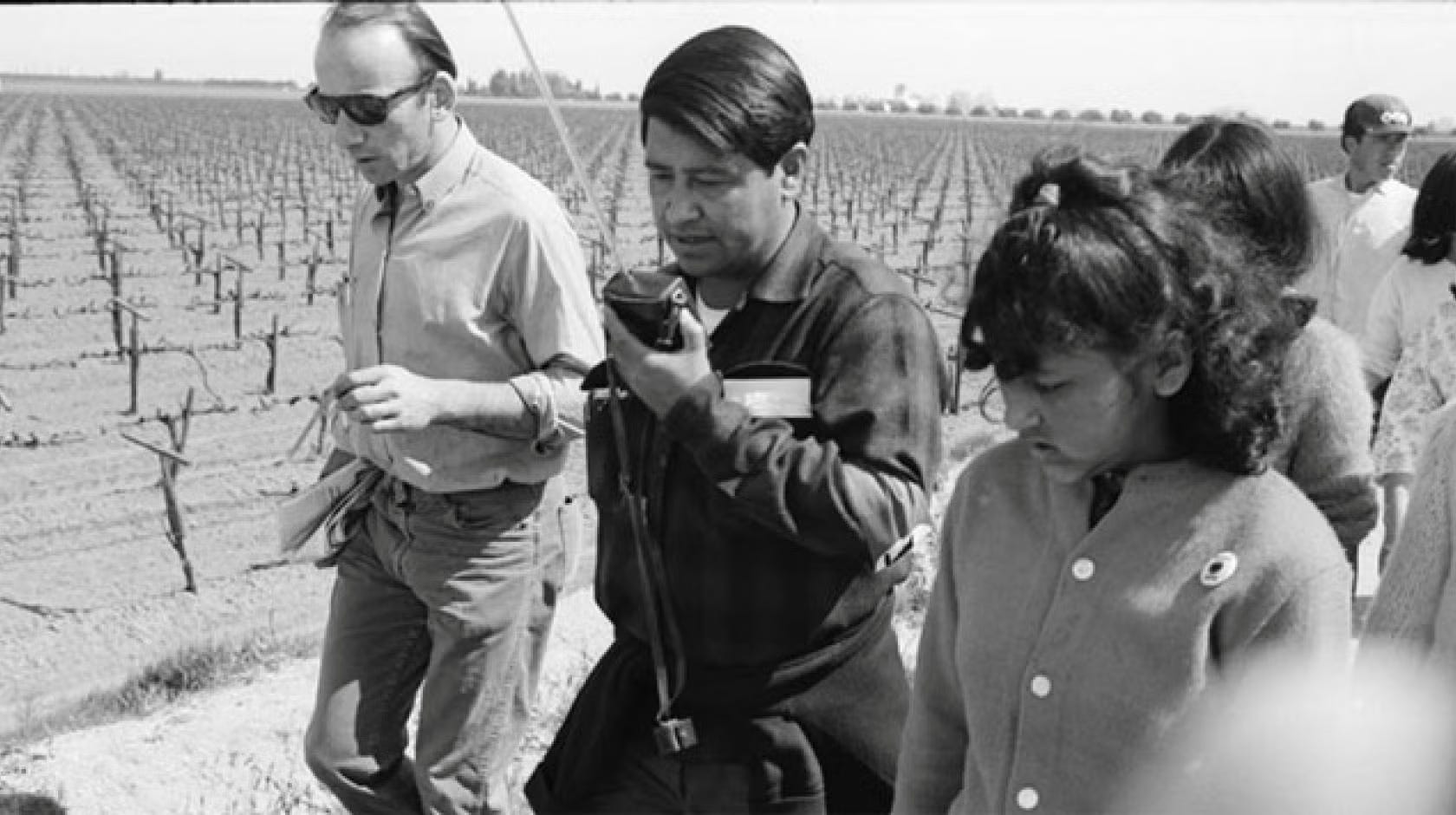
In California, our kids grow up learning about Cesar Chavez, the fight for farm workers’ rights, the movement that grew from a single idea into a national symbol. I read The New York Times’ extensive investigation on Wednesday morning as soon as it was published. I couldn’t sleep after I read it.
I’ve never believed any person is perfect. I’ve spent decades in politics and seen the flaws of great leaders and weak ones alike. But this story did something different. It took something long celebrated as a triumphant movement and revealed the darker truth underneath.
It made me think about early in the first Trump administration, when I attended an event at Rob Reiner’s home, may his soul rest in peace. He joked something along the lines, “No one in your administration grabbed them by the pussy.” I was holding a wine glass. I’m still surprised it didn’t crack from the grip, tightening with frustration. That we could be so naïve, that we could believe sexism, abuse, and worse only happened on one side of the aisle.
For those decades I’ve worked in politics and I’ve learned up close that there are good and bad on both sides of the aisle. And for the powerful, regardless of party, there has always seemed to be a different set of rules.
A Movement Built on a Secret
When I woke Wednesday night, tossing and turning — now myself eight months pregnant, cycling between the stories I’d read and dreams I couldn’t shake — I kept thinking about Dolores Huerta.
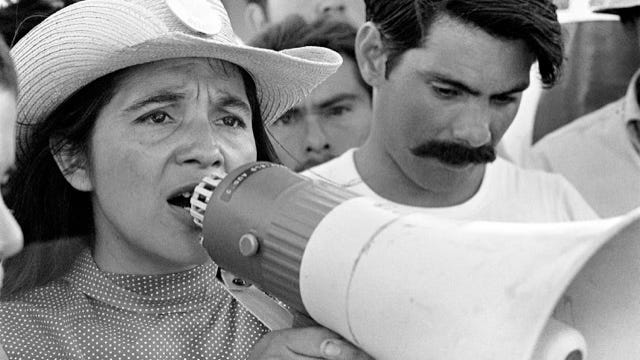
Huerta co-founded the United Farm Workers alongside Chavez. For sixty years, she kept a secret. She told the Times that Chavez pressured her into sex and, in a second encounter, raped her. Both encounters led to pregnancies she hid, children she arranged to be raised by other families, because she believed that exposing the truth would destroy the farmworker movement she had spent her life building.
The Times investigation also revealed that two other women said Chavez began sexually abusing them when they were 12 and 13 years old. Barely teens. Girls around my son’s age. It sickened me.
I kept thinking about a friend of mine: a strong, justice-oriented woman, the granddaughter of the famed civil rights leader Cesar Chavez, and what it must feel like to learn something this devastating about a man whose legacy she’s carried. To stand for women’s rights, equal rights, justice and then discover this, or live through it becoming public.
Huerta herself described Chavez in The Times as “It’s kind of like a Dr. Jekyll and Mr. Hyde situation I think.” I cannot imagine she’s the only one who felt it.
I cannot fathom disguising a pregnancy, giving birth, and placing your child in the hands of others to conceal the truth for another, someone who was supposed to be your partner. But I also cannot imagine believing that the fight for so many people’s freedom is so fragile that the whole movement would fall if its leader were exposed. That your secret if told could cause so much more struggle. When the cause feels that enormous, what decision do you make?
The Lion and the Predator
When the MeToo movement erupted, I remember thinking that there’s a thin line between a dog and a predator. I heard at the time that some of the accused had taken polygraph tests on whether they had raped the women who accused them. They passed. I wasn’t surprised. I honestly don’t think they believed it was rape. They thought everyone loved them.
MeToo only started a conversation we are still having. With the Epstein files, with decades of abuse by people who were supposed to be pious, whether the Catholic Church, or Presidents, or civil rights icons, it all connects.
The thing is, we have long had an imbalance of power, and that imbalance is genderless, really it’s amorphous. Whether it’s a young boy who is powerless and abused, or a woman perceived as powerful who feels she cannot speak because she is beholden to someone else’s legacy to make progress, the people at the bottom of that imbalance are rarely entirely free to make their own choices.
That is the deeper story underneath the Chavez headlines. And it is not unique to him.
Abuse of Power Has No Party, No Race, No Religion
I remember sitting at a dinner in DC with a group of conservative women, insiders from the first Trump administration. We were talking about the imbalance of power — I said how wrong it was that abuse happened, a political scandal of a President (Clinton) bore the name of a young woman (Lewinsky), and so many were willing to look the other way. They looked at me and said: “It’s happening again.” Everyone in their world is aware of indiscretions in their own ranks, but unable or unwilling to tarnish the legacy of a leader for fear that their objectives would not be achieved.
Is that how progress gets made, by burying indiscretions in real time?
This is not a partisan problem. It is not a problem of one race, one religion, one movement, one party. We have seen it in the Catholic Church and in the labor movement. We have seen it in Hollywood and in Washington. We have seen it from the left and the right, from the pious and the secular, from the celebrated and the obscure. The Epstein files touch figures across every ideological spectrum.
There are outstanding accusations against people in this current administration: Pete Hegseth, whose own mother’s anger came to light ahead of his confirmation hearing. Donald Trump, who Elon Musk posted would be named in the sealed Epstein files — and Musk’s own name has since surfaced in those same documents.
I know there are people who could tell the truth. I know of credible accusations involving people in previous administrations too.
The Chavez story forces us to hold two things at once. First, that a movement genuinely improved the lives of farm workers, and second that a man who led that movement used his power to violate the most vulnerable around him. That reckoning is not comfortable.
We need to learn that when we lionize an individual rather than a cause, we hand that individual enormous power to abuse; and we make the people around him or her feel that their silence is the price of the movement’s survival. That power creates an unhealthy imbalance.
Sunlight Is the Only Disinfectant
I was genuinely impressed by how swiftly the United Farm Workers acted publicly, though I imagine that behind the scenes, it was not swift at all. Stories like this are a long time coming as a general rule, and The Times had been working on this story for five years which is an exceptionally long time and shows a significant amount of diligence.
When faced with the imminent publication, the UFW removed themselves from Cesar Chavez Day celebrations. Family members did not deny the accusations; they said they had trouble reconciling them. The institution moved.
So what do we think we gain by staying silent? Is a movement only as strong as its leading lion, even when the lion is also a predator?
If we truly want to reconcile the imbalance of power, we have to remove the shroud of secrecy. We have to hold people accountable, regardless of which side of the aisle they stand on, which community they come from, which cause they champion. And perhaps we should stop lionizing individuals in the first place. In my experience, we are all capable of great sins.
As much as I tossed and turned thinking about the stories of suffering I read last week, I am glad people are telling them. I only wish more would. Sunlight is the greatest disinfectant. And justice — for all of us and for the next generation — can only begin with the truth.
How was this not brought to light earlier? Almost 60 years ago? I know abusive families keep secrets buried a long time, I lived it myself. My dad sexually abused my sisters and it was almost 30 years before it was brought to light. It messed up family bonds, as my father tried to blame it away on others. He made amends and stayed with my mom, my sisters forgave him, but it made us uncomfortable having around our grandchildren. It is hard to build back a trust that should never have been broken.
Thank you so much for your article on abuse!
Thank you!